|
The General Magazine
|
The General
was first published in 1964, as a bi-monthly periodical
devoted to supporting Avalon Hill's line of wargames, with
articles on game tactics, history, and industry news.
Wargaming in the modern recreational sense was in its infancy,
and The Avalon Hill Game Company had been producing wargames
for a mass market for only five years. The first issue was
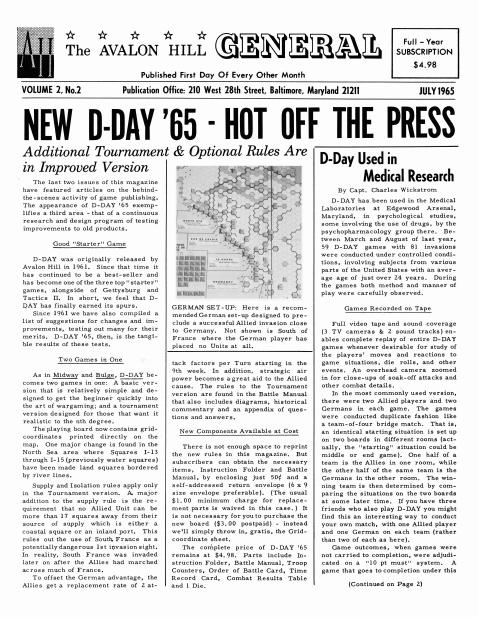
published on 1 May 1964; twelve pages in length with a
six-issue (one year) subscription valued at $4.98 US dollars.
The third issue
featured a $0.25 discount coupon that could be used in any
purchase direct by mail from Avalon Hill (with small print
indicating a minimum of four coupons had to be redeemed at a
time); these coupons would be a regular feature of the
magazine. Volume 2 featured the addition of area editors based
geographically around the United States; article submissions
started to appear with such frequency that area editors were
dropped after Volume 2 Issue 5.1
Volume 3,
Number 1 boasted an expansion to 16 page format. By the fourth
year of publication, many
fanzines and amateur
publications began cropping up, and Avalon Hill promoted the
sale of such, wisely suggesting that these amateur
publications were good for the growth of the wargaming hobby.
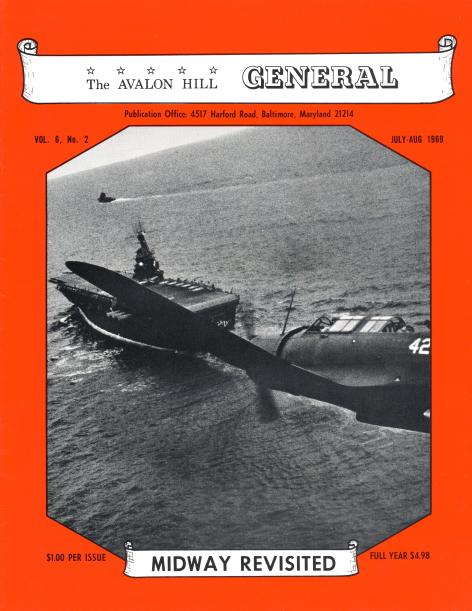
Volume 4 also marked a change from dull paper stock to glossy
paper. Editor Tom Shaw
described the magazine in 1969:
Each issue of the General could reach a
total circulation of 15,000 if you include individual sales.
However, the subscription rate is much lower than that. It is not
offered for sale on the newsstands and that, as you know, is where
the bulk of magazine sales take place in a profitable operation. It
loses money because it is printed on high speed, offset presses at
Monarch Services. This process is geared to runs of 50 to 100
thousand copies, and therefore it is unprofitable to use it
for 15,000. But we do it because Monarch is a member of the
conglomerate owning Avalon Hill. We sell no advertising, and mailing
costs for a small run such as the General incur a low profit margin. |

The General
was printed on attractive heavy duty paper for the majority of
its print run, but the true favourites of the tactical
wargamer that saw heavy wear and tear generally didn't stand
up well to it.
Webmaster's collection.

Avalon Hill also
sold black and white reprints.
Webmaster's collection. |
While in itself it is a losing
venture, in the long run the General makes money for AH because it
is an advertising and promotional vehicle for Avalon Hill's
products. But because it deals strictly with AH products and is
primarily written by those who own the games, it appeals only to
wargamers owning Avalon Hill games, obviously. Appeal to more people
by dealing with more wargaming subjects would, of course, increase
the marketability of the General, but we do not have the editorial
wherewithal to do that.2
As with their games,
then, their magazine benefited from close relationship with a
printing company, guaranteeing high quality product that the
competitors of coming years would find hard pressed to match.
Throughout its run, The General also maintained a relatively
stable printing schedule, meeting deadlines in a manner that other
magazines sometimes struggled with. In 1972, editorship passed from
Thomas N. Shaw to a young Don Greenwood, who was just graduating
from college. Volume 9 Number 1 would be his first issue, and he
would remain at the helm until January 1982 when Rex A. Martin took
over. (Volume 18 Number 5). In July 1992, the editorial duties were
passed on to Don Hawthorne (Volume 28 Number 1).3
In 1973, an
independent reviewer writing in
Moves wrote:
During (1972), the Avalon Hill
General gradually changed its organization, presentation, and
typography. Articles have tended to become longer. Donald Greenwood,
the founder and former editor of
Panzerfaust,
was hired by Avalon Hill. When he returns from Basic Training with
the Maryland National Guard, he is expected to take a major part in
producing the General. The possibility of changing the
magazine's format or length has been raised; it would not be
surprising to see a switch from 16 to 24 pages. On the other hand,
inflation has had an interesting effect; the General is no
longer the "incredibly expensive" magazine that it was in the early
60's - most of the other professional magazines have a higher
subscription rate. Editorial comments in the most recent issue
suggest other changes; articles on variants on AH games will be seen
less, while articles on game tactics will apparently be seen more.4
The same article
pegged the magazine's circulation at 5,000.5
By the 1980s the
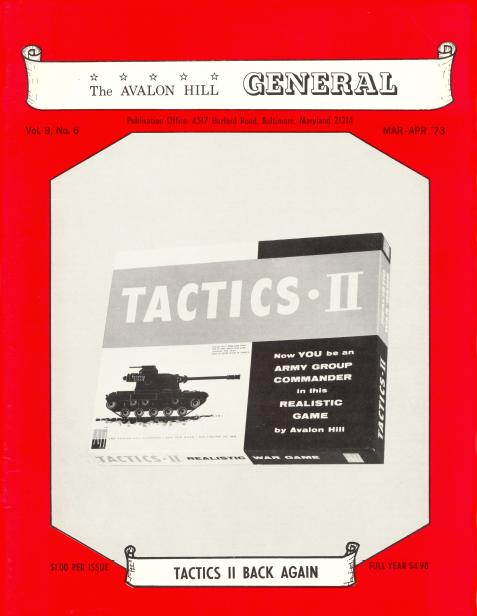
format had become remarkably stable. The cover featured the boxtop art from one of Avalon Hill's games. The Avalon Hill
Philosophy contained industry news from the editor (in early issues,
it was common to mention projects by other companies, but this
practice slowly died out, making the magazine a true, dedicated
house organ). A set of articles
might contain variants, historical background, or
game tactics/strategy discussions for the feature game. The format by this time was 60
pages. A contest in each issue focussed on one particular game in
the AH line, and the answer to a previous contest would appear. Each
issue also had So That's What You've Been Playing showing
statistics of mail-in surveys included in each issue, where players
rated the Avalon Hill (and later, Victory Games) titles they had
been playing according to frequency. A Reader's Buyers Guide rated
Avalon Hill games on overall value, components, complexity,
completeness, playability, availability, and game length (again,
based on the bi-monthly surveys). The Infiltrator's Report featured
news on games in the Avalon Hill pipeline as well as industry news.
The magazine also contained full page advertisements for Avalon Hill
Games (and for a brief period, a pull out section called The
Victory Games Insider featured news and information on Victory
Games products). The Question Box featured questions and
answers regarding rules of various Avalon Hill
Games, published to clarify game playing procedures.
Sports and Computer Games had their own sections, though the meat
and potatoes of Avalon Hill's line were board wargames. Certain
flagship games had semi-regular feature columns, such as
Diplomacy's "The Compleat Diplomat" or Advanced Squad
Leader's "ASL Clinic".
The editorship
changed once again in this period also:
Don's (Don
Greenwood) work load(sic), too, had become impacted by
tremendous product growth. Not so reluctantly he relinquished
control of The General after 60 issues when Rex Martin
came on board as full time editor in '81. A "man of letters" and
dyed-in-the-wool "Diplomacy" player, Rex handled it until the
time he left in the mid-90's.6
As Avalon Hill
increasingly expanded into non-wargaming titles, coverage of same
increased in the page of The General, often to the dismay of
correspondents published in the Letters to the Editor column.
However, ASL fans found that they could find their appetites
whetted by ASL Annual, which began publication in 1989 and
was published semi-regularly until 1997, briefly becoming a
twice-annual.
Don Greenwood
returned as managing editor for a single issue in 1994, credited as
"Executive Editor" (Volume 29, Number 2). In that issue he wrote:
For some time
now, we have been struggling with dwindling boardgame sales.
Critically acclaimed though they may be, time marches on and the
younger generation has voted overwhelmingly with their
entertainment dollars...Every passing season brings news of the
next wave of computer hardware more wondrous than its
predecessor...And so it happens that Avalon Hill is seriously
embracing computer games for the first time. Many of our
previous efforts in this field were admittedly half-hearted and
it showed...We buried our heads in the sand while the
entertainment industry passed us by.
He continued to speak
of a "transition from a predominantly boardgame company to one
depending primarily on computer games." Editorship passed to Robert
Waters, with Gary Fortenberry (former editor of the ASLUG fanzine)
becoming an Associate Editor, acknowledging the importance of the
Advanced Squad Leader property to Avalon Hill. Fortenberry's
duties were editorship of the ASL Annual as well as ASL content in
The General, which Greenwood noted would continue to be one
article and two scenarios in every issue.7 A short notice
in Volume 30, Number 3 indicated that Robert Waters had ceased his
editorship after just seven issues due to "personal considerations."
Stuart K. Tucker was announced as the new editor in the next issue
(Volume 30, Number 4). Gary Fortenberry began to share editorship
with "Multi-Man Publishing" and beginning with Volume 31, Number 2,
MMP appeared alone as the ASL editorship.
The General
ceased publication in the wake of the Avalon Hill buyout by Hasbro
in 1998. The last issue was Volume 32, Number 3.
Cover Gallery/Issue Listing - Regular Issues
Cover Gallery/Issue Listing - Special Issues
 |
Special
ORIGINS
Issue 1988 |
Notes
- Information in this section
condensed from the articles in The General Volume 25 Number 1
(1988)
-
Strategy &
Tactics, March-April, 1969, interview by Chris Wagner
- "The Avalon Hill Philosophy Part
145" (The General, Volume 28, Number 1)
- Phillies, George and Martin
Campion. "A Guide to Conflict Simulation Games and
Periodicals" (Moves,
Nr. 7)
- Ibid.
- Shaw, Thomas N. Confessions of an 84
Year Old Teenager: Trials Tribulations and Joys of Running "the
Greatest Game company that ever lived" (Thomas N. Shaw,
lulu.com, 2014) ISBN 978-1-312-87832-7 p.96
- "The Avalon Hill Philosophy Part
161" (The General, Volume 29, Number 2). Greenwood
felt that the health of the hobby in general was indicated by
the health of "fanzines" and that ASLUG had been a particularly
well respected example of the latter. Fortenberry was also noted
in the article as second place finisher at AVALONCON 93.
|